10 Tips for Choosing the Best Submersible Motor
A submersible motor works out of sight, often in cold water, a narrow well, or a demanding industrial tank. Choosing one by price or horsepower alone can lead to overheating, poor performance, or costly replacement. The right decision depends on the job: water quality, installation depth, required flow, power supply, and how often the system will run.
This guide uses a composite expert, pump engineer Daniel Mercer, to frame a practical reminder: “Match the motor to the conditions it will face, not just the numbers on the box.” This is an illustrative quotation, not a verified statement from a named industry professional. Before comparing models, check the manufacturer’s performance curves and installation requirements. A motor suited to clean groundwater may not be appropriate for abrasive or contaminated fluids. Small details matter. Cable length, cooling flow, and compatible controls can affect reliability as much as rated power.
The ten tips ahead offer a clear way to assess those details, compare specifications, and ask better questions before purchase. They cannot replace site measurements or a qualified technical review. And some choices remain imperfect: a lower upfront cost may mean a shorter service life, while extra capacity can waste energy. A careful selection starts with the actual operating conditions—and leaves room to verify assumptions.
Match motor output to the pump’s duty point: flow, head, and kW
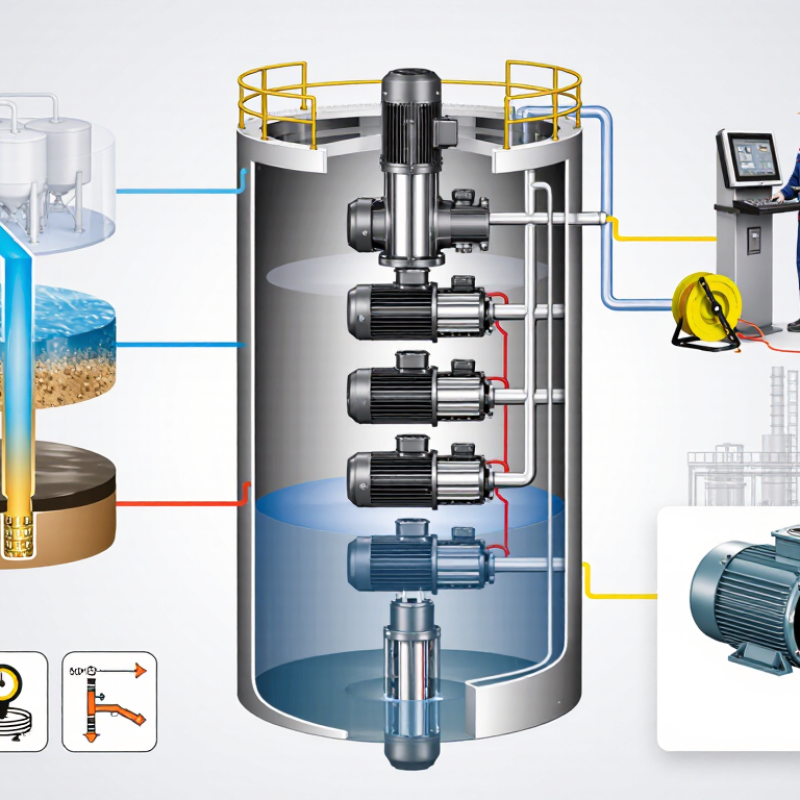
A submersible motor should be sized for the pump’s actual duty point, not its maximum catalog rating. Start with required flow and total dynamic head, including lift, pipe friction, and pressure at the outlet. Then check the pump curve: the duty point should sit near the pump’s best efficiency point, not at the far edge. That detail matters. A motor that is too small may overheat or fail to deliver the required flow; an oversized one can waste energy and operate poorly under light load. The U.S. Department of Energy’s Improving Pumping System Performance sourcebook describes the pump affinity laws: power demand rises roughly with the cube of speed. Small speed changes can therefore have a noticeable energy effect.
Convert the selected duty point into the pump’s required shaft power, then allow for the motor’s operating conditions. Confirm voltage, frequency, cooling, submergence, and service factor with the manufacturer’s technical data. For example, a pump lifting water through a long, narrow discharge line may need more power than static lift alone suggests. Use measured flow and pressure where possible; estimates can miss friction losses. A spreadsheet can still mislead. Recheck the calculation against the actual curve and installation conditions, and avoid choosing extra kilowatts as a substitute for that check. DOE’s sourcebook also emphasizes evaluating the whole pumping system, rather than treating the motor as an isolated component.
10 Tips for Choosing the Best Submersible Motor
Match motor output to the pump’s duty point: flow, head, and kW.
Illustrative duty points show how power needs change with flow and head. Estimated shaft power assumes 60% pump efficiency and is calculated from water power (ρgQH) divided by efficiency. Confirm the actual pump curve, efficiency, operating range, and motor rating before selection.
Check the power supply: rated voltage, 50/60 Hz frequency, and phase
Before comparing motor horsepower, read the supply details on the nameplate: rated voltage, frequency, and phase. A motor marked 230 V, 60 Hz, single-phase is not automatically suitable for a 230 V, 50 Hz supply. Frequency affects motor speed and can change pump flow and head. For a two-pole motor, synchronous speed is about 3,000 rpm at 50 Hz and 3,600 rpm at 60 Hz; actual induction-motor speed is slightly lower. The IEC 60034-1 rotating-machine standard specifies rated conditions and operating tolerances, but those allowances are not a substitute for checking the pump manufacturer’s limits.
Tip: Match all three supply details to the installation. Confirm whether the site provides single- or three-phase power, and measure voltage at the motor connection under load if possible. A long cable run can cause voltage drop. For example, a motor may start normally on a short test lead yet struggle through a long, undersized cable. That detail is easy to overlook.
For variable-frequency drives or generators, verify compatibility with the motor’s rated frequency and voltage, then check the pump’s permitted operating range. The U.S. Department of Energy’s Improving Pumping System Performance sourcebook recommends evaluating pumps as part of the full system, not in isolation. That is useful here: the correct electrical match must also suit the required flow, discharge pressure, and duty cycle. A quick visual check can miss a mismatch; record the nameplate data and compare it with the actual supply before installation.
Verify enclosure and insulation: IEC 60529 IP68 and Class F at 155°C
10 Tips for Choosing the Best Submersible Motor
Check the enclosure rating against the actual installation, not just the product label. Under IEC 60529, IP68 indicates protection against dust and continuous immersion under conditions specified by the manufacturer. It does not establish one universal immersion depth or duration. Ask for the tested depth, duration, and cable-entry details. A wet cable gland can defeat an otherwise well-sealed housing.
Tip: Verify insulation class and test records. IEC 60034-1 identifies Class F insulation with a 155°C thermal class limit. That figure is not a recommended continuous water temperature; winding temperature also depends on ambient conditions, motor loading, and temperature rise. Request the motor’s rating data and insulation test documentation, then compare them with the duty cycle. A warm casing alone proves little.
Look for evidence from qualified testing, including enclosure checks after assembly and insulation-resistance measurements. Confirm whether the stated rating applies to the complete motor, including joints and leads. Ask how the unit handles frequent starts, sediment, and changing water levels. Small details matter. I would still inspect the seal arrangement in person where possible; paperwork can be correct, yet installation practice can be less than perfect.
Compare rated-load efficiency using applicable IEC 60034 requirements
When comparing submersible motors, check rated-load efficiency under comparable test conditions. IEC 60034-2-1 describes methods for determining motor losses and efficiency; confirm which method the supplier used. The applicable requirements can depend on motor type, rating, and operating conditions. A figure without its test basis is hard to judge.
Tip: Compare like with like. Match rated output, voltage, frequency, and duty before reviewing efficiency values. Ask for the test report, not just a catalogue number. Check whether the stated value reflects the motor alone or a complete pump-and-motor assembly. Those are different comparisons. Keep the documentation.
In practice, a small efficiency difference may matter over long operating hours, but installation conditions also affect energy use. A motor running away from its rated load may not achieve its published figure. Review the expected load profile, cooling arrangement, and starts per hour alongside the IEC-based data. I would still question a neat comparison if the test conditions are missing; real wells are rarely so tidy.