

Top 10 Tungsten Alloy Turning Tips for Global Buyers
Tungsten Alloy Turning demands more than a sharp insert and a powerful lathe. Global buyers must evaluate machinability, alloy grade, part geometry, supplier experience, and process stability before approving production. Tungsten alloys are extremely dense and hard. They also conduct heat differently from common steels, which can concentrate stress near the cutting edge.
Dr. E. O. Ezugwu, a recognized researcher in difficult-to-machine materials, has stated, “The machining of difficult-to-cut materials requires careful control of cutting conditions.” That principle matters here. A small change in cutting speed can alter tool wear, surface finish, and dimensional accuracy. Coolant delivery must reach the cutting zone, not merely wet the machine enclosure. Stable workholding also matters, especially when thin sections vibrate under high cutting forces.
This guide presents ten practical Tungsten Alloy Turning tips for global buyers. It covers insert selection, conservative parameters, chip control, coolant strategy, tool inspection, and quality verification. Buyers should request trial data, tool-life records, tolerance results, and inspection reports. Supplier claims alone are not enough.
The process is not perfectly predictable. Grain structure, binder content, and prior heat treatment can change the cutting response. That uncertainty deserves attention. A successful supplier will explain those variables clearly, measure results honestly, and adjust the process when evidence demands it. Even experienced teams can overlook heat buildup or edge chipping. Careful testing remains the safer path.
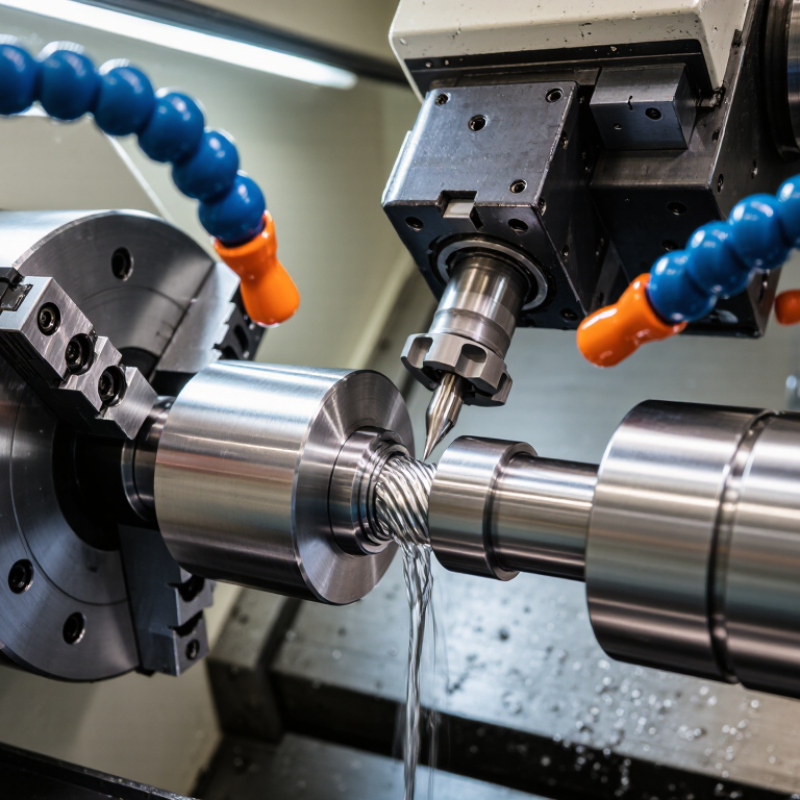
Understanding Tungsten Alloy Grades and Turning Challenges
Top 10 Tungsten Alloy Turning Tips for Global Buyers
Understanding Tungsten Alloy Grades and Turning Challenges
Tungsten heavy alloys usually contain 90–97% tungsten by weight. Common grades include W-Ni-Fe and W-Ni-Cu systems. The binder changes toughness, machinability, magnetism, and corrosion behavior. A 95W-Ni-Fe grade can resist deformation, but its hard tungsten particles may quickly wear ordinary carbide inserts. W-Ni-Cu is often selected when lower magnetism matters, although cutting behavior still depends on density and sintering quality.
USGS Mineral Commodity Summaries 2025 estimated 2024 global tungsten mine production at about 81,000 metric tons. China accounted for roughly 67,000 metric tons. This concentration makes grade verification and supply traceability important for global buyers. Ask for density, composition, hardness, grain structure, and lot-specific inspection records. Do not rely only on a grade name.
Turning requires a rigid setup, minimal tool overhang, and controlled cutting forces. Experienced machinists often use sharp carbide or advanced cutting tools, generous coolant, and conservative feeds. Interrupted cuts are especially risky. Small chips can appear before visible tool damage. That detail is easy to miss. ASM machining guidance also emphasizes workholding stability when cutting hard, brittle materials. Yet no published parameter fits every alloy. Tool geometry, machine rigidity, and the actual binder phase can change results. Trial runs remain necessary, and buyers should budget for imperfect first-pass machining.
Top 10 Tungsten Alloy Turning Tips for Global Buyers - Understanding Tungsten Alloy Grades and Turning Challenges
| No. | Alloy Grade / Typical Composition | Typical Density | Primary Turning Challenge | Turning Tip | Starting Cutting Guidance | Buyer Quality Check |
|---|---|---|---|---|---|---|
| 1 | W-Ni-Fe heavy alloy Commonly 90–97 wt% W, with nickel–iron binder | Approximately 17.0–18.5 g/cm³, depending on tungsten content and porosity | High density, hardness, and abrasive tungsten particles accelerate tool wear | Use a rigid setup, minimize tool overhang, and avoid interrupted cuts where possible | Begin conservatively around 20–60 m/min cutting speed with carbide tooling; adjust after wear inspection | Request tungsten percentage, binder chemistry, density, hardness, and lot traceability |
| 2 | W-Ni-Cu heavy alloy Commonly 90–97 wt% W, with nickel–copper binder | Approximately 17.0–18.5 g/cm³ | Copper-containing binder can produce different chip formation and dimensional response than W-Ni-Fe | Do not assume identical parameters across binder systems; qualify each grade separately | Use a sharp, strong positive-geometry carbide insert and stable coolant delivery | Confirm binder type, electrical properties, density, dimensional tolerances, and corrosion requirements |
| 3 | High-tungsten grade Approximately 95–97 wt% W | Usually about 18.0–18.5 g/cm³ | Greater tungsten content generally increases density and can reduce machinability | Prioritize roughing stability and leave a consistent finish allowance for the final pass | Use light, controlled finishing cuts; avoid rubbing by maintaining adequate feed | Verify density by the applicable test method and check for segregation, cracks, and open porosity |
| 4 | Medium-tungsten grade Approximately 90–94 wt% W | Typically about 17.0–18.0 g/cm³ | The lower tungsten fraction does not eliminate burrs, edge chipping, or heat concentration | Use a dedicated deburring operation and protect sealing or mating surfaces | Start with moderate feed and depth of cut; monitor burr height and insert edge condition | Compare actual density and hardness with the purchase specification, not only nominal grade |
| 5 | Carbide cutting tool selection Coated or uncoated cemented carbide is commonly evaluated | Not applicable | Tool wear may appear as flank wear, edge rounding, chipping, or crater wear | Use a tough grade with a sharp but sufficiently supported edge; replace inserts before dimensional drift | Avoid worn tools and excessive honing, which can increase cutting forces and rubbing | Ask for tool-life trials, insert geometry, edge preparation, and measurable wear criteria |
| 6 | Cutting speed control Parameter must match grade, tool, diameter, and machine rigidity | Not applicable | Excessive speed raises cutting temperature and can shorten tool life rapidly | Use constant surface speed only when the machine can maintain stable control; otherwise use a conservative fixed speed | A practical trial window is about 20–60 m/min for carbide turning; validate with tool-wear data | Require a documented process window rather than a single unverified speed value |
| 7 | Feed and depth of cut Stable chip thickness is more important than aggressive material removal | Not applicable | Too light a feed may cause rubbing; too heavy a cut can chip the insert or distort the workpiece | Use a consistent feed, moderate radial engagement, and separate roughing from finishing | Establish feed and depth of cut through a short trial matrix rather than relying on generic steel data | Review cycle time, tool life, surface roughness, and dimensional capability together |
| 8 | Coolant and chip evacuation Flood or high-flow delivery is commonly considered for heat and chip control | Not applicable | Poor chip evacuation can recut abrasive particles and damage the finished surface | Direct coolant at the cutting zone and keep the work area free of recirculated chips | Use clean, filtered coolant compatible with the alloy and downstream cleaning process | Specify coolant concentration, filtration level, residue limits, and corrosion-control requirements |
| 9 | Dimensional and surface-finish control Thermal growth and tool wear can affect final measurements | Not applicable | Heavy workpieces may require secure support, while abrasive chips can scratch precision surfaces | Measure after thermal stabilization and use separate clean gauges for final inspection | Define surface roughness, roundness, cylindricity, and dimensional limits before production approval | Request inspection records, sampling plans, calibration evidence, and a representative machined sample |
| 10 | Safety, packaging, and shipment planning Machined tungsten alloy is dense and may have sharp edges or coolant residue | Shipment weight is high relative to component volume | Manual handling, impact damage, corrosion staining, and inaccurate freight calculations | Use edge protection, suitable lifting instructions, corrosion-resistant packaging, and moisture control | Confirm net weight, gross weight, packaging dimensions, export classification, and destination requirements | Approve packaging drawings, marking language, certificates, and pre-shipment photographs before dispatch |