

Our Blog
Check out our innovative pump solutions and industry insights to see what's new in the pumping industry. Stay up to date with the latest trends and news in the world of pumping technology by following our pumping technology blog.
- Home
- Blog
Top Industrial Display Screen Manufacturers Worldwide
Choosing an Industrial Display Screen is not simply a matter of selecting the brightest panel or the largest size. In a factory, a screen may face oil mist, vibration, gloves, and long shifts under harsh lighting. In a control room, legibility, viewing angle, and dependable operation may matter more. The right choice depends on where the display will work and how people will use it.
Design and usability expert Don Norman wrote, “Good design is actually a lot harder to notice than poor design, in part because good designs fit our needs so well that the design is invisible.” That principle offers a useful lens for evaluating industrial displays: clear information and responsive controls should support the task, not distract from it. Details matter.
This guide surveys worldwide manufacturers, including Advantech, Winmate, Axiomtek, Siemens, and Hope Industrial Systems. It compares product focus, panel formats, touch options, environmental protection, connectivity, and support considerations. Specifications deserve careful reading. A quoted brightness level, for example, does not reveal how easily an operator can read a screen beside a sunlit loading bay. Nor does a product label alone prove suitability for a particular installation. Buyers should verify current datasheets, operating limits, and service coverage with each manufacturer. The companies discussed are not presented as a universal ranking; needs differ by site, budget, and application. Even careful comparisons leave room for uncertainty. Real-world testing may expose weaknesses that a product page cannot show.
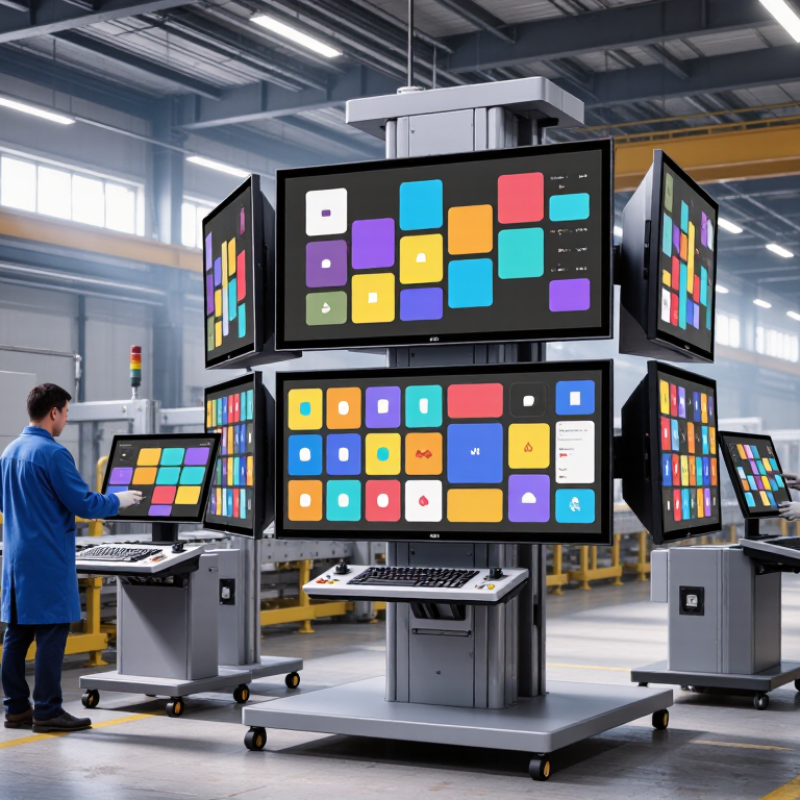
Industrial Display Screens: Core Technologies and Product Categories
Industrial display screens are built around a few core technologies, each suited to different operating conditions. TFT LCD panels are common because they offer clear images, stable performance, and many size options. For a control cabinet under bright factory lights, high brightness and anti-glare treatment can make readings easier to see. Optical bonding reduces reflections and helps prevent dust or moisture from collecting between layers. Details matter.
Touchscreens add another layer of choice. Projected capacitive touch supports responsive, multi-point input, while resistive touch can work with gloves or a stylus. The right option depends on the operator, the task, and the surrounding equipment. Heat changes things. LCD performance may shift across wide temperature ranges, so buyers should check the panel’s rated operating limits rather than rely on a room-temperature demonstration.
Product categories include open-frame monitors for equipment integration, panel-mount displays for control panels, and rugged units for vibration-prone areas. Some systems also use sunlight-readable screens or specialized protective glass. Interfaces, mounting dimensions, and cable routing deserve attention before installation; a suitable screen can still be awkward to service. OLED may suit applications needing strong contrast, but long-term image retention should be considered where static dashboards remain visible for hours. These trade-offs are easy to miss in a specification sheet. Testing the display in its actual enclosure can reveal glare, heat buildup, or touch issues that a catalogue cannot.
How Industrial Displays Differ Across Major Application Sectors
Industrial displays differ because each sector exposes screens to different failures. In factories, operators need clear alarms through vibration, dust, and glove use. Sealed front panels, physical controls, and wide temperature tolerance can matter more than pixel density. IFR’s World Robotics 2024 report counted 4.28 million industrial robots operating worldwide in 2023. More automation means more interfaces, but not every station needs a touchscreen.
Clinical displays serve a different task. Staff must read small labels and changing values under bright room lights, often while wearing gloves. Cleanable surfaces and stable image settings matter; diagnostic imaging also requires purpose-built calibration, not a standard control-room panel. Airports prioritize visibility across crowded halls and quick replacement. IATA reported global passenger demand rose 10.4% in 2024, adding pressure to keep flight information legible and current. Crowds move fast.
Outdoor utility and transport screens face sunlight, moisture, and wider temperature swings. High brightness helps, but excessive output can increase heat and power use. One specification mistake is treating brightness as a complete measure of readability. Viewing angle, glare, touch response, and maintenance access deserve equal attention. I would still question any “universal” panel claim: a factory washdown area and a hospital console may look similar on paper, yet fail for very different reasons.
Leading Industrial Display Screen Manufacturers by Global Region
Top Industrial Display Screen Manufacturers Worldwide
Leading Industrial Display Screen Manufacturers by Global Region
Industrial display manufacturing is distributed across several regional clusters, each shaped by local supply chains and customer needs. In North America, suppliers often emphasize rugged terminals, integration support, and dependable service for factories and transport systems. Buyers should check actual temperature ratings and ingress protection, not rely on broad “industrial-grade” claims. Details matter.
Across Europe, engineering priorities commonly include long product lifecycles, stable documentation, and compatibility with established automation systems. In East Asia, dense electronics supply chains support a wide range of display sizes, touch technologies, and production volumes. South Asian capacity is also developing, though capabilities vary considerably between facilities. A regional label alone does not prove quality.
For procurement teams, compare manufacturers by measurable performance: brightness in nits, viewing angle, interface options, operating temperature, and stated component availability. Ask how replacement panels are handled after several years; that answer can reveal more than a polished specification sheet. Samples should be tested under real lighting, vibration, and glove-use conditions. I would avoid treating any region as automatically superior. Even experienced buyers sometimes underestimate integration work, especially when a display must fit an existing enclosure or control system. The best regional partner is the one whose engineering evidence, communication, and support match the application.
Key Factors for Comparing Industrial Display Manufacturers
Comparing industrial display manufacturers starts with the operating conditions, not the brightest number on a datasheet. Check required screen size, resolution, viewing angle, touch method, and readable brightness under actual factory lighting. MarketsandMarkets’ Industrial Display Market report estimated a USD 5.8 billion market in 2023 and projected USD 7.4 billion by 2028. That forecast signals demand, not supplier quality. A growing market does not guarantee a reliable panel.
Ask how each manufacturer validates performance across temperature, vibration, dust, and continuous operation. Request test conditions and results, not just claims of “ruggedness.” IEC 60068 environmental testing can help define comparable test methods. Also compare interface options, enclosure modifications, spare-part availability, and product-change notices. A display may pass a lab test yet fail when mounted behind thick protective glass. Lifecycle support matters, too: ask how long components remain available and what happens when a panel is discontinued. These details are easy to overlook.
Tips: Send shortlisted suppliers the same operating profile and sample application. Compare their written answers, warranty terms, and replacement lead times. Keep one uncomfortable question: what has not been tested?
Top Industrial Display Screen Manufacturers Worldwide - Key Factors for Comparing Industrial Display Manufacturers
| Comparison Factor | What to Compare | Useful Evidence to Request | Why It Matters |
|---|---|---|---|
| Display Size and Resolution | Active screen dimensions, native resolution, aspect ratio, and pixel density. | Product datasheet and a mechanical drawing showing the active area and overall dimensions. | These specifications determine whether the display fits the enclosure and presents the required information clearly. |
| Brightness and Readability | Specified luminance in cd/m², surface treatment, and readability under the intended lighting conditions. | Datasheet with luminance measurement conditions; request a sample review in the expected ambient light. | Readability depends on the display and its installation environment, including ambient light and reflections. |
| Operating Temperature | Published operating and storage temperature ranges for the complete display assembly. | Product datasheet and, where required, environmental test reports for the exact configuration. | Temperature limits differ by product. Compare the stated limits with the equipment’s real operating and storage conditions. |
| Ingress Protection | Whether an IP rating is specified, and which parts of the assembly the rating covers. | Test documentation identifying the tested configuration and applicable IP code under IEC 60529. | IEC 60529 classifies degrees of protection provided by enclosures. A rating should be checked against the assembled product, not assumed from a display panel alone. |
| Electromagnetic Compatibility | Available emissions and immunity test results for the product and intended installation. | Test reports or declarations that identify the product configuration and applicable standards in the target market. | The IEC 61000 series covers electromagnetic compatibility topics, including immunity and emissions. Requirements depend on the application and market. |
| Environmental Durability | Evidence relating to vibration, shock, humidity, or other environmental conditions relevant to the installation. | Test reports that state the test method, severity, duration, and tested product configuration. | The IEC 60068 series contains environmental testing methods. Select tests that reflect the actual use case rather than relying on a general durability claim. |
| Touchscreen Performance | Touch technology, supported input methods, multi-touch capability, and operation with gloves or moisture if needed. | Touch-controller specifications and a hands-on test using the intended gloves, interface, and operating conditions. | Touch performance can vary with the display assembly, controller settings, gloves, water, and electromagnetic conditions. |
| Interfaces and Integration | Video and control interfaces, connector type, cable length limits, mounting options, and driver compatibility. | Interface specification, connector pinout, mechanical drawing, and compatibility confirmation for the host system. | Early compatibility checks can reduce integration work and help avoid connector, signal, or mounting mismatches. |
| Product Lifecycle and Supply | Product change notification process, stated availability, lead times, and continuity options. | Written lifecycle policy, change-control procedure, and a supply plan for the expected project period. | Industrial equipment may remain in service for many years; supply and change management should be assessed for each project. |
| Quality and Traceability | Documented quality controls, production traceability, and management-system certifications relevant to the supplier. | Current certificates, scope details, sample inspection records, and lot or serial-number traceability information. | ISO 9001 specifies requirements for a quality management system; certification scope and the products or sites covered should be verified. |
| Warranty and Technical Support | Warranty period and exclusions, repair or replacement process, engineering support, and response arrangements. | Written warranty terms and support procedures that apply to the exact product and sales region. | Warranty coverage and support commitments are supplier-specific commercial terms, so they should be compared directly rather than assumed. |
Emerging Trends in the Worldwide Industrial Display Market
Industrial display demand is moving beyond basic status panels toward brighter, touch-enabled interfaces for factory floors, vehicles, and process-control rooms.
MarketsandMarkets’ Industrial Display Market report projected growth from US$5.2 billion in 2023 to US$7.0 billion by 2028, a 6.1% annual growth rate.
That forecast reflects wider automation and demand for clearer, faster operator feedback. A technician wearing gloves needs buttons large enough to press without stopping a line. Small details matter.
Displays are also being designed for harsher conditions: sunlight, vibration, coolant mist, and long operating shifts. High-brightness panels, optical bonding, and glove-compatible touch can improve readability, but they add cost and may complicate repairs. Not quite simple.
Edge-connected screens increasingly present machine data and alarms near the equipment, reducing trips to a central control room. Yet more information is not always better; crowded screens can slow decisions.
Buyers should test viewing angles, touch response, and readability under actual lighting, not only in a showroom. Forecasts are useful, but they are not shop-floor guarantees.
A specification can look excellent on paper and still fail after years of heat, dust, and daily cleaning.