

loading

Our Blog

Check out our innovative pump solutions and industry insights to see what's new in the pumping industry. Stay up to date with the latest trends and news in the world of pumping technology by following our pumping technology blog.

Top Skin Tone Analyzer Types for Global Buyers

A Skin Tone Analyzer can help brands compare complexions with greater consistency, but no device reads skin in isolation. Lighting, camera distance, calibration, and the area measured can all shift a result. A warm shop lamp may make a cheek look more golden; window light can reveal details the lamp hides. Small differences matter.

Anthropologist Nina Jablonski’s research on human skin pigmentation offers an important reminder: skin color varies widely and reflects complex biological and environmental factors. Paraphrased for analyzer selection, her work cautions against treating a single reading as a complete description of a person’s skin. That distinction is easy to overlook.

This guide compares the main analyzer types global buyers may encounter, including handheld colorimeters, imaging-based systems, and software-led tools. Each offers different trade-offs in portability, repeatability, operating conditions, and data detail. Buyers should ask how a device is calibrated, which skin areas it measures, and whether its results remain comparable across locations. A polished dashboard is not proof of accuracy.

There is no universal winner. A clinic, cosmetics lab, and retail counter may need different tools. Even a well-tested instrument can produce misleading results when users skip calibration or rely on one reading. The comparisons that follow focus on practical strengths and limits, so buyers can match a Skin Tone Analyzer to its intended use—and question the result when the conditions are imperfect.
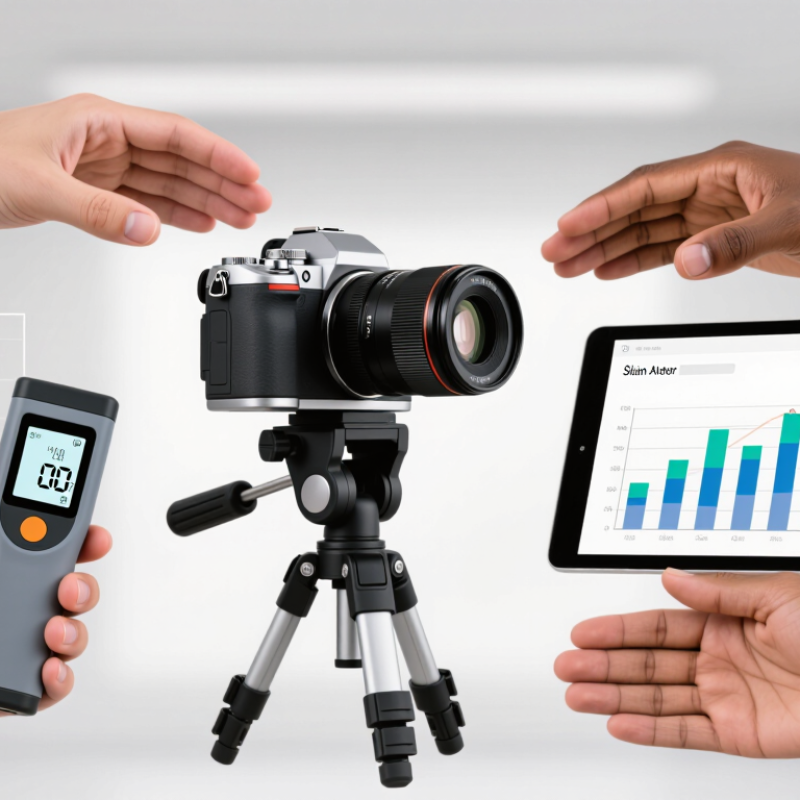
Top Skin Tone Analyzer Types for Global Buyers

What Is a Skin Tone Analyzer and What Does It Measure?

A skin tone analyzer is a device or software system that estimates skin color from reflected light or an image. It may use a handheld sensor, a camera, or both. The result is more structured than a casual visual description. Under the CIE 1976 L*a*b* color space, measurements use three coordinates: L* for lightness, a* for the green-to-red axis, and b* for the blue-to-yellow axis. This framework is specified in ISO/CIE 11664-4:2019. Small changes in lighting can shift readings. Calibration matters.

Some analyzers also estimate undertone or melanin-related values, but these are model outputs, not direct diagnoses. A reading can help compare areas, track changes, or guide cosmetic shade matching. It does not explain why skin looks a certain way. For example, a warm lamp can make a cheek appear more golden, while a shadow may lower its measured brightness. CIE colorimetry standards offer a common measurement language, yet devices may differ in sensors and algorithms. That gap is real. A neat number can still oversimplify skin, especially when redness, dryness, or uneven pigmentation affects the sampled area. For consistent comparisons, measure clean, makeup-free skin under steady lighting and use the same device settings each time.

How Do Skin Tone Analyzers Classify and Record Skin Color?

Skin-tone analyzers classify color from reflected light or calibrated photographs. Imaging systems estimate color from pixels, while spectrophotometers measure light reflected from a small skin area. A cheek reading can differ from a forehead reading because of redness, oil, or recent sun exposure. Small shifts matter.

For consistent records, operators control lighting, camera distance, and measurement location. Many systems express color in CIE L*a*b*: L* represents lightness, while a* and b* describe red-green and yellow-blue axes. The ISO/CIE 11664-4:2019 standard defines this color space. Numbers need context. Device calibration and skin preparation should be recorded alongside readings, since room light or makeup can distort results.

Some analyzers also assign categories. The Fitzpatrick scale has six phototypes, but it describes typical response to ultraviolet exposure, not precise skin color. A 2022 ACM CHI research paper presented a 10-shade reference scale for more granular visual assessment. These approaches are not interchangeable. Buyers should check whether a device stores raw color values, category labels, or both, and whether repeat measurements remain stable across skin tones. Even careful measurement has limits. An algorithm may still misclassify unusual lighting or undertones.

What Are the Main Types of Skin Tone Analyzers?

Skin tone analyzers generally fall into three groups: handheld colorimeters, spectrophotometers, and camera-based systems. A colorimeter reads reflected light across selected color channels and can provide quick, repeatable measurements on a small area. It is useful for comparing cheek or forehead readings, though pressure and placement can affect results. Small details matter.

Spectrophotometers capture reflected light across a broader range of wavelengths. This can produce more detailed color data, making them useful in research, product development, and controlled consultations. Some models also assess related skin characteristics, but a color reading alone does not diagnose a condition. Calibration and consistent measurement conditions remain important.

Camera-based analyzers use images to estimate tone, often through a phone or dedicated imaging device. They are convenient, but lighting, camera settings, makeup, and image processing may shift the result. A reading near a window can differ from one under a warm indoor lamp. That is a real limitation, not just a technical footnote. Visual shade scales are another practical option: a trained user compares skin with printed or digital references. They are affordable and easy to explain, yet less precise between observers. Buyers should match the analyzer type to the task, then check how it performs across different skin tones and everyday lighting.

Top Skin Tone Analyzer Types for Global Buyers

What Are the Main Types of Skin Tone Analyzers?

The chart compares common output structures, not accuracy or performance: visual reference scales assign a shade category, tristimulus colorimeters report three color values, and RGB imaging systems record three color channels. Spectrophotometers produce wavelength-dependent reflectance data; the number of sampled wavelengths varies by instrument.

How Do Analyzer Types Differ in Accuracy and Application?

Skin tone analyzers do not measure the same thing. Colorimeters record reflected light in defined color channels, making them useful for repeatable shade checks during product development. Results are quick. But readings can shift with probe pressure, placement, or a dry patch of skin. Spectrophotometers capture reflected light across more wavelengths, helping describe subtle undertones and support controlled comparisons. They are often more informative, not automatically more accurate. Calibration, probe geometry, and ambient light still matter.

Camera-based systems suit broad, contact-free screening, such as mapping variation across a cheek or forehead. Yet exposure, white balance, shadows, and device differences can distort results. Handheld melanin-index meters serve narrower tasks, such as tracking pigment-related changes under consistent conditions. They do not describe every visible color difference. For global buyers, match the instrument to its intended use: controlled lab comparisons often favor spectral measurement, while fast retail guidance may favor imaging. Ask how devices were validated across skin tones, measurement sites, and lighting. That question is easy to miss. No device removes judgment entirely, and careful operators remain essential.

Top Skin Tone Analyzer Types for Global Buyers - How Do Analyzer Types Differ in Accuracy and Application?

Analyzer type What it measures or assesses Accuracy considerations Typical applications Strengths and limitations Global buyer considerations
Visual assessment and Fitzpatrick questionnaire A person's reported tendency to burn or tan after ultraviolet exposure; visual assessment may also describe apparent skin color. Results depend on respondent recall, assessor judgment, and wording. Fitzpatrick skin phototype describes UV response, not an objective measurement of skin color. Initial clinical screening, dermatology records, and research protocols that specifically require a phototype classification. Low cost and simple to use; less repeatable than instrumental measurement and may not represent the full range of skin tones or UV responses. Use locally understandable, validated questions and trained assessors. Avoid treating phototype as a direct color reading.
Tristimulus colorimeter Reflected color, commonly expressed in a color space such as CIE L*a*b* under specified measurement conditions. Repeatability depends on calibration, measurement geometry, contact pressure, site selection, and skin surface condition. It records color values rather than UV-response type. Cosmetic product development, color-change monitoring, and standardized measurements at selected skin sites. Portable and generally straightforward to operate; provides less spectral detail than a spectrophotometer. Check calibration procedures, measurement aperture, device repeatability data, and whether the supplier provides a consistent protocol for different skin tones.
Reflectance spectrophotometer Wavelength-dependent reflected light, which can be used to derive color coordinates and support analysis of skin pigmentation. Often offers more detailed color measurement than a tristimulus colorimeter, but results still depend on instrument configuration, calibration, site, and protocol. No device is universally accurate for every use case without validation. Clinical and academic research, formulation studies, and quantitative evaluation of skin color or pigmentation changes. Provides spectral information useful for controlled comparisons; may require higher investment, operator training, and careful site standardization. Review the wavelength range, measurement geometry, calibration documentation, data export options, and evidence across the intended population.
Melanin and erythema index meter Optical indices related to melanin and redness, typically calculated from reflected light at selected wavelengths. Index values are method- and device-dependent, so they should not be assumed to be interchangeable across instruments. Site, pressure, and recent sun exposure can affect readings. Pigmentation research, redness monitoring, and before-and-after assessment in controlled studies. Can provide focused numerical indices; values are not necessarily equivalent to a full color measurement or a clinical diagnosis. Ask for the index definitions, repeatability data, and recommended comparison protocol. Confirm that results are suitable for the intended skin tones and body sites.
Standardized digital imaging Skin appearance in photographs; software may estimate color or classify tone from image pixels. Highly sensitive to illumination, camera processing, exposure, white balance, background, and image compression. Calibration and consistent capture conditions are essential for meaningful comparisons. Telehealth documentation, visual tracking, consumer-facing assessment, and large-scale image-based research when properly standardized. Convenient and can capture broad areas; uncontrolled photographs can produce misleading color estimates and may perform unevenly across skin tones. Evaluate performance across diverse skin tones, lighting environments, and camera models. Review consent, image security, and data-protection requirements in target markets.
Multispectral or hyperspectral imaging Images captured across multiple wavelength bands; systems may estimate skin properties from spectral patterns. Potentially richer information than a standard color image, but accuracy depends on sensor design, illumination control, calibration, processing methods, and validation for the intended population and task. Specialist research, detailed skin analysis, and applications requiring spatial maps or multiple spectral measurements. Can capture spatial and spectral data; generally involves greater system complexity, cost, data volume, and analysis requirements. Assess calibration support, software transparency, training needs, file compatibility, maintenance, and evidence for the precise application before purchase.
Selection note: “Accuracy” is application-specific. Compare instruments using repeatability, calibration, measurement conditions, and independent validation for the intended population, body site, and use. Skin color measurement, UV phototype classification, and medical diagnosis are different tasks.

How Can Global Buyers Choose the Right Skin Tone Analyzer?

Top Skin Tone Analyzer Types for Global Buyers

How Can Global Buyers Choose the Right Skin Tone Analyzer?

Start with the decision the reading must support. A handheld colorimeter can provide quick, point-based color measurements, while a spectrophotometer captures reflectance across a wider range of wavelengths. Imaging systems can map larger areas, but results depend heavily on camera setup and lighting. More features do not automatically mean a better fit.

Check how the device performs across the skin tones and conditions relevant to your users. Ask for validation data, repeatability results, and clear guidance on calibration. Test measurements under controlled lighting, then repeat them after repositioning the device. Small changes in pressure, angle, or skin hydration can shift readings. That matters.

Consider how readings will be used and shared. A clinic, cosmetics laboratory, and field research team may need different levels of detail, portability, and data export. Confirm that software units and reports suit your team, and review data-handling practices before purchase. If possible, compare devices using the same participants and protocol. One limitation is easy to miss: a neat numerical output can look more certain than the measurement really is. Choose a system whose uncertainty and operating steps are explained plainly.