

loading

Our Blog

Check out our innovative pump solutions and industry insights to see what's new in the pumping industry. Stay up to date with the latest trends and news in the world of pumping technology by following our pumping technology blog.

How to Choose a Parking Air Heater for Your Vehicle?

Choosing a Parking Air Heater is not simply a matter of selecting the highest heating output. Your vehicle size, climate, insulation, battery capacity, and daily routine all influence the right decision. A compact van used in northern winters needs different equipment from a small car parked outdoors for short periods.

“Comfort should never be separated from safety,” says Holger Engelmann, former chief executive of Webasto, a leading vehicle-heating manufacturer. That principle gives this topic a practical foundation. A suitable Parking Air Heater should warm the cabin efficiently, use fuel responsibly, and operate with dependable controls. Check its rated output, voltage, fuel type, noise level, installation requirements, and available safety protections. Examine the manual, not only the product photograph.

Small details matter. A heater may start smoothly at dawn, yet drain a weak battery after several repeated cycles. A model rated for a large truck may overheat a narrow cabin or waste fuel. That mistake is easy to make. It is also expensive.

Real-world experience deserves attention here. Measure the cabin, inspect the battery age, and consider the lowest temperature you regularly face. Professional installation remains important, especially around fuel lines, exhaust routing, and electrical connections. I would not choose by price alone; that sounds obvious, but many buyers still do it.

This guide compares heater types, heating capacity, controls, energy use, and installation concerns. It also acknowledges an uncomfortable truth: no single Parking Air Heater fits every vehicle. Your best choice may be quieter, smaller, or less powerful than expected.
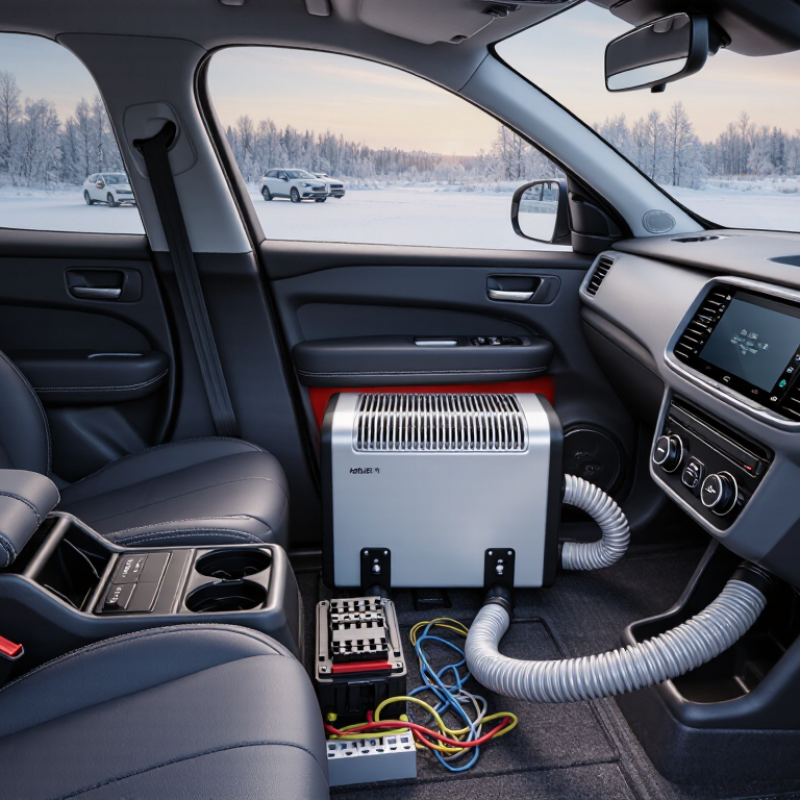
How to Choose a Parking Air Heater for Your Vehicle?

Understanding How a Parking Air Heater Works

How to Choose a Parking Air Heater for Your Vehicle? Understanding How a Parking Air Heater Works

A parking air heater warms cabin air without running the vehicle’s main engine. A small combustion chamber burns a measured amount of fuel. An electric fan moves cabin air across a heat exchanger. Warm air then returns through the outlet, while exhaust gases leave through a separate pipe. This separation matters. It helps prevent combustion gases from entering the cabin when installation and ventilation are correct.

The U.S. Department of Energy reports that an idling passenger vehicle may consume about 0.16–0.39 gallons of fuel per hour, depending on engine size and accessories. A parking heater usually uses far less fuel, but its electric fan and glow plug still draw power. The International Energy Agency has also highlighted transport efficiency and reduced stationary fuel use as important energy-saving measures. Real performance varies with insulation, outside temperature, altitude, and heater settings. My earlier assumption was simple: lower fuel use always means better choice. It does not. A weak battery can create practical problems during cold mornings.

Tips: Check rated heat output, fuel consumption, noise, and current draw. Confirm that the heater matches your cabin size. Select a unit with temperature control and overheat protection. Keep the exhaust outlet away from doors, windows, and air intakes. Read the installation instructions carefully. Professional installation is safer, especially in enclosed parking areas. A carbon monoxide detector adds another useful safeguard. Specifications can look impressive on paper, yet field performance may disappoint without proper ducting.

Matching Heater Output to Your Vehicle and Climate

How to Choose a Parking Air Heater for Your Vehicle?

Matching heater output to your vehicle and climate starts with heat loss, not cabin size alone. A compact car often needs around 2 kW, while a van may require 4–5 kW. A truck sleeper can need 5–8 kW in severe cold. These figures are practical ranges, not universal rules. Window area, insulation, ventilation, and door openings change the result.

The U.S. Department of Energy notes that idling can consume about 0.25 gallons of fuel per hour in a passenger vehicle. Heavy-duty vehicles may consume considerably more.

A correctly sized parking heater can reduce unnecessary engine idling during stationary heating.

The U.S. National Oceanic and Atmospheric Administration’s 1991–2020 Climate Normals provide useful local temperature data. Check the coldest normal conditions, not only the seasonal average. At -20°C, a heater that feels powerful at 0°C may struggle.

A simple estimate helps. Consider cabin volume, exposed glass, and expected temperature difference. A lightly insulated van in northern winters needs more output than a sealed city car.

Smaller heaters can also cycle less efficiently when oversized. That wastes energy and may create uneven warmth. It is easy to choose too much power.

I would also examine altitude, battery capacity, and startup time before fitting. Real conditions are messier than brochures suggest. Personnel should verify airflow and installation against the applicable vehicle and heater safety requirements.

Choosing Between Diesel, Gasoline, and Electric Heater Types

Choosing a parking air heater starts with the vehicle’s fuel system, battery capacity, and parking habits. Diesel heaters suit long winter stops because fuel is stored separately from the starter battery. The U.S. Department of Energy’s Alternative Fuels Data Center lists diesel at about 128,488 Btu per gallon, compared with 120,214 Btu for gasoline. That difference is useful, but not decisive. Heater efficiency, altitude, insulation, and installation quality matter more than a specification sheet suggests.

Gasoline heaters can make sense for gasoline vehicles, especially when carrying another fuel container is inconvenient. However, gasoline vapor demands careful storage, sealed connections, and professional exhaust routing. Never judge safety by cabin temperature alone. Carbon monoxide monitoring remains essential. Electric heaters are quieter and mechanically simpler. A 2-kilowatt unit uses roughly 1 kilowatt-hour during 30 minutes of operation. At 12 volts, that draw approaches 167 amps before losses. Small batteries may struggle.

The International Energy Agency’s Global EV Outlook 2024 reports that electric car sales exceeded 17 million in 2024, showing why electrical thermal loads deserve closer attention. I would not choose electric power automatically. A cold battery can deliver less energy, and real-world range may fall sharply. My practical preference is cautious: match the heater to verified electrical capacity, fuel compatibility, and climate records, then ask a qualified technician to check combustion air and exhaust clearance. Specs can look perfect. Installations can still disappoint.

Checking Fuel Use, Power Demand, Installation, and Safety

Choosing a parking air heater begins with fuel use, not the advertised heat output. A compact cabin may need less energy than a large van. Check the heater’s fuel rate at low and high settings. I once underestimated this difference, and the extra fuel use became noticeable during long winter stops. A small tank can empty sooner than expected. Diesel, petrol, or another approved fuel must match the heater’s specifications.

Power demand also deserves careful attention. Most heaters use modest power after starting, but ignition can draw more from the battery. Measure the battery’s condition, capacity, and charging performance. Cold weather reduces available capacity. Leave enough power for the engine. A voltage monitor can reveal problems before the heater shuts down. I still prefer testing the setup overnight, because calculations do not always match real conditions.

Installation affects both comfort and safety. The combustion chamber must remain sealed from the cabin. Exhaust gases need a secure route outside, away from doors, windows, and air intakes. Fuel lines should avoid heat, sharp edges, and moving parts. Mounting must be firm, with protection against vibration and water. Follow the installation manual closely, or use a qualified technician. Carbon monoxide detection is essential. Ventilation still matters. Inspect connections regularly, especially after rough travel. A rushed installation may look acceptable, but hidden leaks can develop later.

Comparing Controls, Maintenance Needs, and Total Ownership Cost

How to Choose a Parking Air Heater for Your Vehicle?

A parking air heater should fit your routine, not only your vehicle’s size. I have found that simple controls often work best during freezing mornings. A timer can preheat the cabin before departure. A thermostat prevents unnecessary fuel use. Remote controls add convenience, but their batteries and signal range need attention. App-based controls may feel advanced. However, poor reception can make them frustrating in rural areas. Check whether the heater supports manual operation when technology fails.

Maintenance affects comfort and ownership cost. Inspect the air intake, exhaust outlet, wiring, and fuel lines regularly. Dusty filters can reduce airflow and increase operating time. Blocked exhaust parts create serious safety risks. Professional installation and periodic safety checks are essential. Follow the supplied maintenance schedule and local vehicle requirements. I once focused too heavily on purchase price. That was a mistake. Installation, fuel, electrical repairs, and replacement parts can cost more over several winters.

Tips: Compare the full three-year cost before buying. Include installation, fuel, battery wear, servicing, and possible downtime. Ask for realistic service intervals, not optimistic estimates. Choose controls you will actually use. A basic timer may beat a complicated remote. Keep receipts and record unusual smells, weak airflow, or repeated shutdowns. Small warnings matter.