

Our Blog
Check out our innovative pump solutions and industry insights to see what's new in the pumping industry. Stay up to date with the latest trends and news in the world of pumping technology by following our pumping technology blog.
- Home
- Blog
China Best Welded Pipe Manufacturer for Global Buyers
Choosing the best Welded Pipe manufacturer in China requires more than comparing price lists. Global buyers need evidence, process control, and consistent communication. A reliable supplier should show how steel becomes a tested product, not merely present attractive photographs.
John C. Lippold, a respected welding metallurgy expert, has stated, “Welding is a process, not merely a product.” This principle matters on every production line. It begins with traceable steel coils or plates. It continues through forming, welding, heat treatment, inspection, and surface protection. Buyers should ask for material certificates, weld procedure qualifications, dimensional reports, and non-destructive testing records. ERW, SSAW, and LSAW pipes serve different pressure, diameter, and application requirements. The correct choice depends on engineering data, not sales language.
Details reveal manufacturing discipline. Walk through a capable factory, and you may see calibrated welding equipment, marked pipe bundles, and inspectors checking ovality with gauges. Ultrasonic testing can identify hidden weld imperfections. Hydrostatic testing can confirm pressure resistance when specified by the project. Coating thickness also deserves attention, especially for outdoor or buried pipelines. Relevant standards may include ASTM, API, EN, or project-specific requirements. Compliance must be verified for the actual order.
No manufacturer is perfect. Even a strong supplier can face delays, material variation, or communication gaps. That weakness should be acknowledged openly. Clear inspection plans and independent pre-shipment checks reduce uncertainty. The best partner is not always the cheapest. It is the manufacturer that documents its work, answers difficult questions, and delivers Welded Pipe consistently across repeated orders.
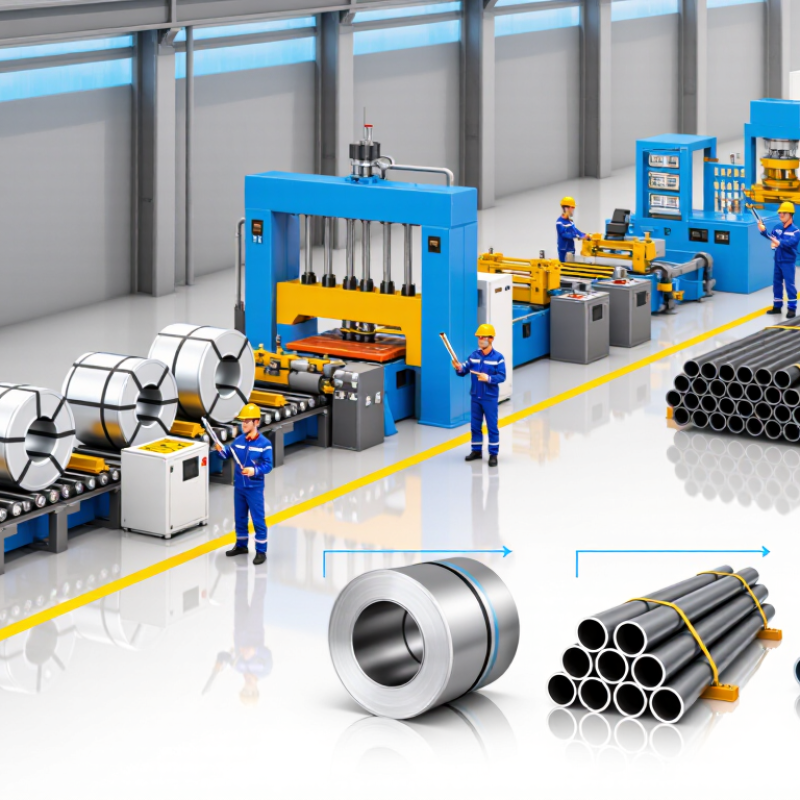
Welded Pipe Basics: ERW, LSAW, SSAW, Diameters, and Wall Thickness
Welded pipe selection starts with manufacturing method, not catalog diameter. ERW forms steel strip and joins the seam with electric resistance. It suits many water, structural, and moderate-pressure services. LSAW bends heavy plate and welds a straight longitudinal seam. It offers strong dimensional control for large diameters and demanding transmission lines. SSAW forms a spiral seam from steel coil. It can produce very large outside diameters efficiently, though seam geometry requires careful inspection. The right process depends on service conditions. Not appearance.
Diameter describes the outside or nominal size, depending on the project specification. Wall thickness affects pressure capacity, stiffness, weight, and corrosion allowance. A larger pipe is not automatically stronger. A thin wall may deform during lifting or installation. Engineers should check design pressure, temperature, fluid, support spacing, and joining method before approval. In practical inspections, I compare caliper readings at several points because one measurement can hide ovality. Small details matter.
Reliable supply requires traceable heat numbers, material certificates, weld inspection records, and dimensional reports. Ultrasonic testing can reveal internal discontinuities, while hydrostatic testing checks pressure integrity when specified. I once underestimated coating damage during transport; the pipe passed production checks but needed site repair. That mistake changed my checklist. Mill certificates alone are not enough. Buyers should clarify end preparation, length tolerance, testing level, coating, packing, and applicable standards in writing. Clear documents reduce disputes, but they cannot replace independent verification on critical projects.
Manufacturing Process: Welding Speeds, Forming Methods, and Heat Treatment
China Best Welded Pipe Manufacturer for Global Buyers
Welding speed shapes output, heat input, and seam quality. According to the World Steel Association’s 2024 statistics, global crude steel production reached about 1.89 billion tonnes in 2023. That scale increases pressure on welded pipe mills to produce consistently, not merely quickly. In high-frequency electric resistance welding, typical line speeds may range from 20 to 120 metres per minute, depending on diameter, wall thickness, and steel grade. Submerged arc welding usually moves far slower, often around 0.5 to 3 metres per minute.
Speed is only one variable. Roll forming supports efficient production of smaller and medium-size pipes, while UOE and JCOE forming suit larger diameters and heavier walls. Each method leaves a different forming history. Excessive forming force can create edge strain, springback, or ovality near the weld. A 2023 technical review in the Journal of Materials Research and Technology links forming control with residual stress and fatigue performance. The details matter.
Heat treatment can correct some problems, but it cannot hide poor welding. Seam normalizing commonly uses controlled temperatures near the steel’s transformation range, often about 850–950°C for carbon steels. ASM Handbook guidance stresses temperature uniformity and cooling control. Operators should verify hardness, microstructure, and weld penetration after treatment. Small temperature deviations can matter. We still see mills focus on speed while recording too little thermal data. That deserves reconsideration.
Global Standards: API 5L, ASTM A53, ASTM A106, and ISO 3183
A reliable welded pipe manufacturer must understand more than steel grades and outside diameters. Global buyers often require API 5L or ISO 3183 for pipeline service, where pressure control, toughness, and traceability matter. Each pipe should carry clear heat numbers, weld records, dimensional results, and inspection data. Small gaps in records can create large problems during installation.
ASTM A53 is commonly selected for water, air, structural, and general pressure applications. It covers welded and seamless pipe, but the correct grade and manufacturing method still need confirmation. ASTM A106 is different. It is generally specified for seamless carbon steel pipe in high-temperature service. A welded pipe supplier should not claim A106 compliance casually. The project specification must permit the product type.
During production, practical controls make the standards meaningful. Operators monitor forming pressure, welding current, alignment, and heat input. Non-destructive testing can reveal incomplete fusion or hidden cracks. Hydrostatic testing then checks pressure performance under controlled conditions. Results should be reviewed by trained inspectors, not accepted as paperwork alone. That sounds obvious.
Experienced suppliers also compare the buyer’s service conditions with the selected standard. Temperature, fluid type, wall thickness, corrosion allowance, and joining method can change the recommendation. Certificates are useful, but they do not replace independent verification when risk is high. No standard fits every project perfectly. Misreading one clause may affect an entire pipeline section.
China Best Welded Pipe Manufacturer for Global Buyers - Global Standards: API 5L, ASTM A53, ASTM A106, and ISO 3183
| Standard | Primary Scope | Manufacturing Types | Common Grades | Minimum Yield Strength | Minimum Tensile Strength | Typical Size and Wall Thickness Reference | Key Inspection or Test Requirements | Typical Applications | Welded-Pipe Relevance |
|---|---|---|---|---|---|---|---|---|---|
| API 5L | Line pipe for transportation systems in the petroleum and natural gas industries. | Seamless and welded pipe, including electric-resistance-welded and submerged-arc-welded product forms. | Grade B, X42, X52, X60, X65, X70 and other specified grades, depending on the applicable product specification level. | Grade B: 245 MPa minimum X42: 290 MPa minimum X52: 360 MPa minimum | Grade B: 415 MPa minimum X42: 415 MPa minimum X52: 460 MPa minimum | Outside diameter, wall thickness, length and dimensional tolerances are ordered according to the applicable API 5L product and purchase requirements. | Chemical analysis, tensile testing, bend testing where applicable, hydrostatic testing, dimensional inspection and visual examination. PSL2 generally includes additional controls compared with PSL1. | Oil and gas transmission pipelines, gathering systems, water transmission and other pressurized line-pipe services. | Directly applicable |
| ASTM A53 / A53M | Seamless and welded black and hot-dipped galvanized steel pipe for mechanical and pressure applications. | Type S: seamless Type E: electric-resistance-welded Type F: furnace-butt-welded | Grade A and Grade B | Grade A: 205 MPa minimum Grade B: 240 MPa minimum | Grade A: 330 MPa minimum Grade B: 415 MPa minimum | Commonly specified by nominal pipe size, schedule or wall thickness, outside diameter, length and end finish. Available in standard, extra-heavy and other listed wall designations. | Tensile testing, bend or flattening testing depending on product type, hydrostatic testing, dimensional checks and visual inspection. | Structural supports, low-pressure fluid service, water lines, air lines, steam service and general industrial piping. | Directly applicable |
| ASTM A106 / A106M | Seamless carbon steel pipe for high-temperature service. | Seamless only; the standard does not cover welded pipe. | Grade A, Grade B and Grade C | Grade A: 205 MPa minimum Grade B: 240 MPa minimum Grade C: 275 MPa minimum | Grade A: 330 MPa minimum Grade B: 415 MPa minimum Grade C: 485 MPa minimum | Typically specified by nominal pipe size and schedule or nominal wall thickness. Hot-finished and cold-drawn seamless products are covered subject to the standard requirements. | Tensile testing, bending or flattening testing as applicable, hydrostatic testing, dimensional inspection and visual examination. | High-temperature process piping, steam lines, refineries, power plants and petrochemical facilities. | Not a welded-pipe standard |
| ISO 3183 | Steel pipe for pipeline transportation systems in the petroleum and natural gas industries. | Seamless and welded pipe, with manufacturing route, grade, delivery condition and testing defined by the purchase specification. | L245, L290, L360, L415, L450, L485 and other specified line-pipe grades, corresponding broadly to strength classes used in international pipeline procurement. | Typical grade values correspond to the specified strength class; for example, L245 has a 245 MPa minimum yield strength and L360 has a 360 MPa minimum yield strength. | Typical grade values correspond to the specified strength class; for example, L245 has a 415 MPa minimum tensile strength and L360 has a 460 MPa minimum tensile strength. | Outside diameter, wall thickness, length, end configuration and dimensional tolerances are specified according to the ordered pipe category and project requirements. | Chemical analysis, tensile testing, weld inspection where applicable, hydrostatic testing, dimensional inspection and non-destructive examination according to the ordered product category. | Cross-border pipeline projects, oil and gas transmission, gas distribution and other pipeline transportation systems. | Directly applicable |
| Procurement note: Exact grade, product specification level, pipe manufacturing process, outside diameter, wall thickness, length, end finish, coating, inspection level and documentation should be confirmed in the project purchase specification. Mechanical-property values shown are representative minimum requirements for commonly referenced grades and should be verified against the current edition of the applicable standard. | |||||||||
Quality Control: ISO 9001, 100% UT, Hydrostatic Testing, and MTRs
China’s welded pipe manufacturers serve demanding infrastructure, energy, and process industries. Quality control must be visible, not merely promised. The ISO Survey 2023 reported more than one million ISO 9001 certificates worldwide. Yet certification alone cannot prove every pipe is sound.
Our inspection approach links production records to each heat and pipe number. Operators perform 100% ultrasonic testing on the weld seam, using calibrated equipment and documented acceptance criteria. UT can reveal lack of fusion, cracks, or incomplete penetration. It cannot replace sound welding practice.
Hydrostatic testing follows the applicable specification and agreed purchase order. Technicians record pressure, holding time, temperature, and visible leakage. Small details matter. A gauge calibration delay can weaken confidence.
Material test reports identify chemical composition, yield strength, tensile strength, elongation, and heat number. These records let buyers compare delivered pipes with the approved specification. They also support traceability during installation and future maintenance.
The World Steel Association reported global crude steel production of about 1.89 billion tonnes in 2023. At that scale, consistent inspection is essential. Still, no quality system is flawless. Sampling assumptions, operator judgment, and incomplete documentation deserve regular review. Independent witnessing can add useful control for critical orders.
Buyer Selection: Capacity, 20-Foot Loads, Coating Options, and Export Terms
China Best Welded Pipe Manufacturer for Global Buyers
Buyer Selection: Capacity, 20-Foot Loads, Coating Options, and Export Terms
Choosing a welded pipe manufacturer requires more than checking a production figure. A reliable supplier should show stable monthly capacity, mill equipment, inspection procedures, and recent shipment records. Ask for actual production schedules, not only advertised maximum output. Request material certificates, dimensional reports, and pressure-test records for comparable orders. Numbers matter.
A 20-foot container needs practical planning. Confirm pipe length, outside diameter, wall thickness, bundle weight, and loading limits before placing an order. Some sizes leave unused space, while others exceed safe weight limits. A detailed loading diagram can prevent expensive adjustments. Do not guess.
Coating selection also affects cost and service life. Options may include black oil, galvanized, epoxy, or polyethylene protection, depending on soil, moisture, and transport conditions. Clarify coating thickness, surface preparation, testing, and end protection in writing.
Export terms deserve equal attention. Confirm whether the quotation uses FOB, CFR, or CIF pricing, and identify who handles inland transport, insurance, customs documents, and port charges. Packaging should protect pipe ends from impact and keep bundles stable during sea transport.
In my experience, small document errors cause more delays than production problems. A realistic supplier admits capacity limits and explains possible risks. That honesty is useful. A weak point remains: forecasts can change, so delivery dates should include reasonable coordination time.