

loading

Our Blog

Check out our innovative pump solutions and industry insights to see what's new in the pumping industry. Stay up to date with the latest trends and news in the world of pumping technology by following our pumping technology blog.

2026 Top Twin Screw Air Compressor Buying Guide

Compressed air is easy to overlook until a production line slows, a tool loses pressure, or the compressor room grows hot. The U.S. Department of Energy’s Improving Compressed Air System Performance sourcebook reports that compressed air can use about 10% of industrial electricity, and up to 30% in some facilities. That makes equipment selection an energy decision, not just a price comparison. Small details matter.

A Twin Screw Air Compressor may suit facilities needing steady, continuous airflow. Two meshing rotors compress air as it moves through the machine. But the right model depends on real demand: required flow, operating pressure, daily load pattern, ambient temperature, and air quality. Check delivered free air, not only the advertised motor power. Compare specific power and part-load performance, too. A spreadsheet can still mislead. Peak demand and leaks deserve attention before buying.

This 2026 guide explains how to compare compressor capacity, fixed-speed and variable-speed options, cooling systems, controls, and service requirements. It also considers oil-injected and oil-free designs, since the right choice depends on the process and downstream treatment. Ask suppliers for performance data under stated test conditions, plus maintenance intervals and warranty terms. The DOE sourcebook emphasizes system-level efficiency, so assess dryers, filters, storage, and piping alongside the compressor. A low purchase price can look attractive. It may not stay attractive after years of energy use and maintenance.
2026 Top Twin Screw Air Compressor Buying Guide

Twin Screw Air Compressors: Core Design and Operating Principles

2026 Top Twin Screw Air Compressor Buying Guide

Twin Screw Air Compressors: Core Design and Operating Principles

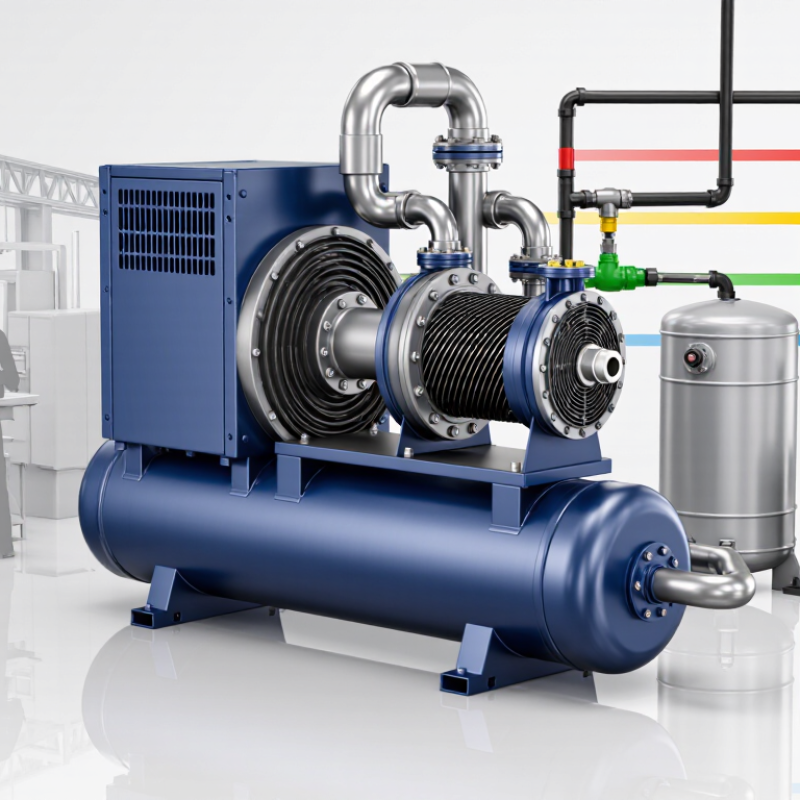
A twin-screw compressor uses two intermeshing helical rotors inside a close-fitting casing. Air enters through the inlet port and fills pockets between the rotor lobes. As the rotors turn, these pockets move toward the discharge end and shrink, raising the air pressure. The process is continuous, unlike the repeated intake and compression strokes of a piston compressor.

The rotor profile, built-in volume ratio, and discharge-port position shape compression behavior. Oil-injected designs use oil to lubricate, seal, and remove heat inside the compression chamber. Oil-free designs keep oil out of that chamber, often using separate timing gears to maintain rotor clearance. Small clearances matter. But neither design is automatically more efficient; load pattern, cooling, controls, and maintenance all affect actual performance.

System conditions matter, too. The U.S. Department of Energy’s Improving Compressed Air System Performance reports that leaks can waste 20–30% of compressor output. That figure describes system losses, not twin-screw efficiency. It is a useful caution when comparing machines: a pressure rating alone cannot show how much air reaches the tools. Check operating pressure, flow demand, inlet conditions, and the compressor’s performance data at the expected load. Even then, site measurements may reveal a less tidy picture.

How Compressor Types and Configurations Differ

Twin screw compressors differ in how they handle oil, speed, and changing air demand. Oil-injected models suit many general-purpose systems, but the air may need suitable downstream filtration. Oil-free designs reduce oil contamination risk at the compression stage; confirm the required air-quality class for your process. Neither type is automatically the right choice.

Drive and cooling configurations matter, too. Fixed-speed units run at a steady rate, while variable-speed models adjust output as demand changes. That flexibility can help with fluctuating loads, though savings depend on the actual duty cycle. Air-cooled packages are often simpler to install; water-cooled systems may fit sites with cooling-water infrastructure. Check inlet temperature, available space, and peak flow—not just the average. A tidy specification sheet can still conceal a poor match.

Tips: Log pressure and flow during a normal shift before choosing capacity. Check the duty cycle. Compare service access, noise, and control settings. Small details matter. It is easy to overestimate future demand; leave reasonable room for growth, but avoid sizing around guesses.

Matching Capacity, Pressure, and Air Quality to Your Needs

Choose a twin-screw compressor by matching its usable airflow to your real workload, not just a catalog’s headline capacity. List each tool’s airflow demand and pressure, then note which machines operate at the same time. Include room for changing demand, but avoid buying far more capacity than you need. Oversizing can waste energy, especially when demand stays low.

Pressure must reach the equipment after losses through filters, dryers, and piping. If a tool needs 7 bar, check the required pressure at its inlet—not only the compressor outlet. Higher pressure can increase energy use and worsen leaks. Air quality matters too. Paint equipment, control instruments, and general workshop tools may need different levels of moisture, oil, and particle removal. Confirm the required air-quality class and pressure dew point with equipment documentation. Estimates can be imperfect; measured demand may surprise you.

Tips: Measure flow and pressure during a busy shift. Check the air at the farthest connection. Compare performance at your site’s temperature and altitude before choosing a unit.

2026 Top Twin Screw Air Compressor Buying Guide - Matching Capacity, Pressure, and Air Quality to Your Needs
Selection Factor Practical Planning Range or Target What to Check Buying Guidance
Air demand and capacity Specify required free air delivery (FAD) in m³/min or L/s at the stated discharge pressure. Indicative industrial demand bands at about 7–8 bar(g): 1–3 m³/min, 3–8 m³/min, 8–15 m³/min, and 15–30 m³/min. Use measured or calculated simultaneous demand, including operating shifts, peak events, leakage, and planned expansion. Confirm the supplier’s FAD rating and test conditions. Size to the real demand profile, not the sum of every machine’s nameplate consumption. Consider a suitably sized receiver or multiple compressors for varying loads.
Indicative motor-power range For many oil-injected rotary screw packages around 7–8 bar(g), approximate pairings are: 1–3 m³/min: 7.5–22 kW; 3–8 m³/min: 22–45 kW; 8–15 m³/min: 45–90 kW; 15–30 m³/min: 90–200 kW. Actual FAD per kW varies with pressure, compressor design, cooling conditions, and package configuration. Use these ranges for initial screening only. Compare guaranteed FAD and specific power at the same pressure and operating conditions before selecting a unit.
Working pressure Common package ratings include approximately 7.5–8 bar(g), 10 bar(g), and 13 bar(g). The required pressure should be defined at the point of use. Include pressure losses through dryers, filters, piping, valves, and the distribution network. Check the minimum pressure required by the most demanding equipment. Avoid choosing a higher pressure “just in case.” Raising system pressure increases energy use; about 7% more energy per additional bar is a commonly used rule of thumb, though actual results vary.
Fixed-speed or variable-speed control Fixed-speed units suit steady, relatively constant demand. Variable-speed drive (VSD) units can suit applications with substantial, frequent demand variation. Review the load profile over a representative production period, including minimum demand, peak demand, and hours at each load. Request performance data across the expected operating range. VSD savings depend on the actual load profile and should not be assumed from motor rating alone.
Air quality specification Define the required ISO 8573-1 purity class as a three-part code: particles:water:total oil. For example, Class 2:4:1 identifies separate targets for each contaminant type. Different processes require different purity levels. Check product, process, instrument, and regulatory requirements rather than applying one class to the entire site by default. State the required class at the point of use and identify whether it applies to the complete compressed-air system, including the compressor intake and downstream treatment.
Moisture control and dryer Refrigerated dryers commonly provide a pressure dew point around +3°C. Desiccant dryers are commonly selected for lower dew points, such as −20°C or −40°C. Consider ambient temperature, pipe exposure, outdoor lines, freezing risk, and the pressure dew point required by the process. Match dryer type and capacity to inlet temperature, pressure, flow, and ambient conditions. Check that dryer pressure loss and purge or regeneration air are included in system sizing.
Oil carryover and filtration For ISO 8573-1 total oil Class 1, the limit is ≤0.01 mg/m³ under the standard’s stated measurement basis. Required limits depend on the process. Oil-injected compressors require appropriate downstream treatment where low oil content is needed. Filters do not remove every contaminant, and performance depends on correct sizing and maintenance. Specify the complete required air-quality class and obtain documented performance for the compressor, filters, and dryer as a system. For oil-sensitive processes, assess whether oil-free compression is appropriate.
Cooling, ventilation, and installation Check room temperature limits, ventilation requirements, heat rejection, service clearances, noise limits, and available electrical supply. Confirm whether the package is air-cooled or water-cooled and account for the site’s ambient conditions and cooling-water availability, where applicable. Request installation and heat-rejection data before finalizing the compressor room layout. Poor ventilation can reduce performance and reliability.
Reliability and backup capacity Critical processes may require a standby unit or multiple compressors arranged to maintain supply during maintenance or an equipment fault. Assess the consequence of a compressed-air interruption, maintenance access, available storage, and the time needed to restore production. Choose redundancy based on risk and required availability. Confirm that controls can sequence multiple machines efficiently at changing demand.
Lifecycle cost and service Compare purchase price, energy consumption, planned maintenance, consumables, treatment equipment, and expected service life. Request energy and performance data at the intended pressure and load profile, plus maintenance intervals and required service access. Evaluate total cost of ownership rather than initial price alone. Verify local service capability, parts availability, warranty terms, and monitoring options.

Note: Capacity and motor-power figures are indicative planning ranges, not a substitute for a site-specific assessment. Confirm all performance, purity, and pressure requirements with measured demand and applicable standards.

Comparing Energy Efficiency, Controls, and Total Ownership Costs

2026 Top Twin Screw Air Compressor Buying Guide

A twin screw compressor’s purchase price is only the visible part of its cost. Electricity, maintenance, and downtime shape the bill over years of operation. The U.S. Department of Energy’s Improving Compressed Air System Performance guide identifies compressed air as a significant industrial electricity user. It also reports that leaks can waste 20–30% of compressor output in poorly maintained systems. Small losses add up.

Compare efficiency at your actual pressure and demand, not just the largest number on a product sheet. Ask for measured input power across realistic load points. Variable-speed control can help when demand changes often, but it is not automatically the best choice for steady, full-load operation. Check how the controller handles multiple compressors, unloaded periods, and pressure-band settings. A pressure band set too tightly may cause needless starts or control changes.

Estimate total ownership cost using annual operating hours, local electricity rates, service intervals, and likely downtime. Review the service schedule, separator and filter replacement needs, and access around the machine. A technician should be able to inspect drains and filters without moving half the room. Then compare the estimate with logged power and pressure data after installation. Forecasts are useful, but real demand can be messy. Keep some uncertainty in the budget.

Evaluating Vendors, Installation Requirements, and Service Support

A twin screw air compressor is a long-term equipment decision, not just a motor-and-price comparison. Ask vendors for performance data at your actual pressure and airflow requirements. Request the expected power use, noise level, and maintenance intervals in writing. A polished brochure is useful, but it cannot replace a clear quotation with stated operating conditions. Check what is included: controls, filters, dryer, startup support, and operator training. Small omissions can change the installed cost.

Installation needs a site check before delivery. Confirm floor loading, service clearance, ventilation, electrical capacity, and pipe connections with qualified personnel. Leave room to remove filters and reach the oil separator; a tight corner can turn routine maintenance into a job. Hot discharge air needs a suitable path, too. It sounds obvious. It is still missed. Ask the vendor who handles commissioning, what response time is realistic, and whether spare parts are locally available. Service promises should be specific, not just reassuring. Some buyers focus on uptime targets and overlook travel time or after-hours coverage. That gap is worth questioning. Keep commissioning records and service logs from day one, even if the process feels a little tedious.